

The metric that lies to you
Most customer service dashboards are built around a simple idea: a complaint is a cost. Every contact has a price. Every minute on a call has a price. The goal, in that logic, is to make complaints cheaper, shorter and, ideally, rarer.
So companies deflect. They add chatbots, build mazes of FAQ pages, hide the phone number three menus deep, and celebrate when the “containment rate” goes up.
The problem is that a complaint is not only a cost. It is also one of the very few moments when a customer tells you, for free, exactly where your business is failing. And it is the moment when that customer is paying the most attention to how you behave.
Treating that moment as waste to be minimized is one of the most expensive mistakes a company can make. It just doesn’t show up on the spreadsheet.
The service recovery paradox
In 1992, researchers Michael McCollough and Sundar Bharadwaj gave a name to something many managers had noticed informally: the service recovery paradox. The idea is that a customer who experiences a failure and then sees it resolved well can end up more satisfied, and more loyal, than a customer who never had a problem at all.
It is worth being precise here, because the idea is often oversold. Later research has shown the effect is not universal. It tends to weaken or disappear when:
the failure was severe or affected something important to the customer
the customer had already been failed by the same company before
the recovery felt slow, scripted or grudging
So this is not a license to break things on purpose. The accurate version is narrower and more useful: how you handle a failure often matters more than whether the failure happened.
A customer who never has a problem has no evidence of what you do under pressure. A customer who has a problem and watches you handle it well has seen your real character. That is a much stronger signal than a smooth, uneventful purchase.
What good recovery actually looks like
The hospitality industry has understood this for decades. The Ritz-Carlton is widely reported to give front-line employees authority to spend a set amount, often cited as up to $2,000 per guest per incident, to fix a problem on the spot without asking a supervisor.
Whether or not the exact figure is current, the principle behind it is the real lesson: the person closest to the customer must be able to act. Every approval layer between the complaint and the solution is time during which the customer’s frustration grows and their trust shrinks.
Effective recovery tends to share four traits:
Speed. The first response matters more than the final resolution. Acknowledgment within minutes beats a perfect answer after days.
Ownership. One person owns the problem from start to finish. The customer never has to repeat the story.
Fairness that feels fair. Not just a correct outcome, but a visible effort to understand the customer’s side before deciding.
A little extra. Fixing the problem restores the status quo. A small gesture beyond that is what creates the memory.
Notice what is missing from the list: a script, a template and a canned apology. Customers detect those instantly, and they read them as indifference.
The AI temptation
Now add generative AI to this picture.
The promise is obvious and, in part, legitimate. AI can answer routine questions instantly, at any hour, in any language, at a fraction of the cost. For simple, low-stakes requests such as order status, opening hours and password resets, it can be a genuine improvement over waiting on hold.
The danger is in the scope creep. When a company sees the savings on routine contacts, the natural next step is to push automation toward everything, including the complaints. That is precisely where it does the most damage.
Two cases show the risk from different angles.
Klarna. The Swedish fintech announced in 2024 that its AI assistant was doing the work of hundreds of agents. In 2025, its CEO publicly acknowledged that the company had gone too far in cost-cutting on this front, saying quality had suffered, and began hiring human agents again. The lesson was not that AI failed. It was that optimizing for cost per contact, without protecting the contacts that matter most, backfires.
Air Canada. In 2024, a Canadian tribunal ruled against the airline after its website chatbot gave a customer incorrect information about bereavement fares. The airline argued the chatbot was effectively a separate entity responsible for its own words. The tribunal rejected that. The company is responsible for what its automated systems tell customers.
The second case matters for strategy, not just law: when you put a machine between yourself and an upset customer, you do not transfer the responsibility. You only lose control over how it is exercised.
A simple way to decide what to automate
The mistake is not using AI in customer service. The mistake is using one logic for every type of contact. A more useful distinction is between contacts that are transactions and contacts that are moments of truth.
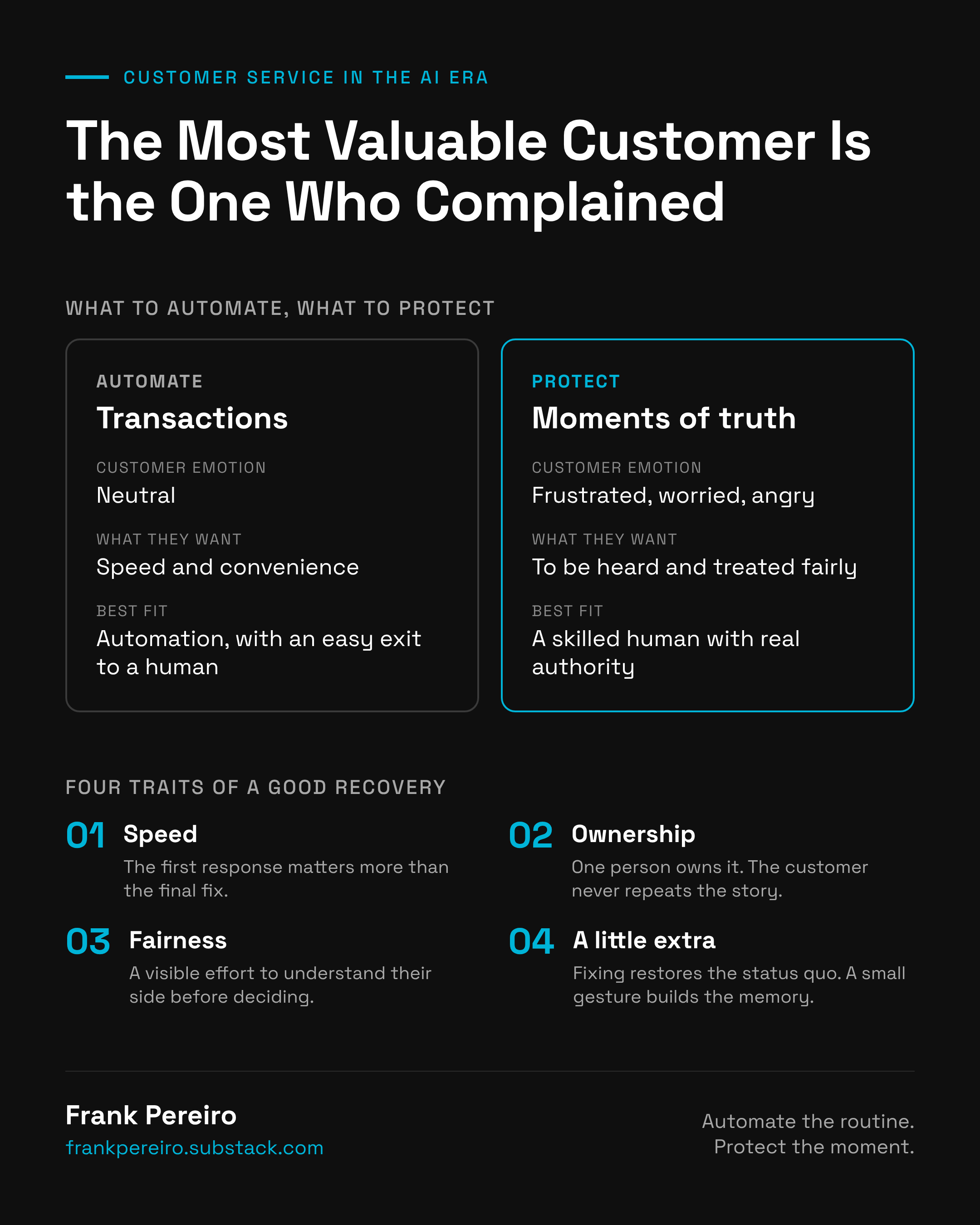
TransactionsMoments of truthCustomer emotionNeutralFrustrated, worried, angryTypical requestStatus, information, simple changesErrors, damage, unfair treatment, high stakesWhat the customer wantsSpeed and convenienceTo be heard and treated fairlyBest fitAutomation, with an easy exit to a humanA skilled human with real authorityRisk if mishandledMild annoyanceLost customer, public complaint, legal exposure
Automate the left column aggressively. Protect the right column deliberately.
And design the boundary carefully. The most damaging experience in modern service is the loop: a customer who clearly needs a person, trapped in a system that will not let them reach one. That is not efficiency. It is a way of teaching customers that your company stops listening exactly when they most need it.
Complaints are data you cannot buy
There is a second reason to value complaints, and it is purely analytical.
For every customer who complains, a much larger group experiences the same problem and says nothing. They simply leave, or quietly spend less. The vocal customer is the visible tip of a pattern.
That makes complaint data one of the highest-quality sources of operational intelligence a company has:
It shows which processes fail repeatedly.
It shows which promises the company makes that it cannot keep.
It shows where policy and common sense disagree.
A company that routes complaints through automation optimized for closing tickets fast often loses this signal. The ticket gets closed. The root cause stays in place. The same complaint arrives again next month, and the dashboard still looks healthy.
The better question to ask of any service operation is not “how quickly did we close this?” but “what did this contact teach us, and what did we change because of it?”
What a strategic approach looks like
For any company thinking seriously about this, the practical implications are fairly clear:
Measure recovery, not just resolution time. Track whether customers who complained came back, and how they rated the handling.
Give front-line staff real authority. Define a spending and decision limit, and trust people inside it.
Make the human path easy to find. If a customer asks for a person, the system should not argue.
Use AI to support people, not to replace the hard conversations. Summaries, suggested answers and instant access to customer history make a good agent faster. They do not make an upset customer feel respected.
Close the loop upstream. Every recurring complaint should have an owner whose job is to remove its cause.
None of this is complicated. What makes it difficult is that it requires seeing a complaint as an investment opportunity instead of a line in the expense report.
The takeaway
In the next few years, nearly every company will have access to the same AI tools, at roughly the same price. Speed and availability will stop being a competitive advantage. They will be the baseline.
What will remain scarce is the experience of being treated well when something goes wrong. That is the moment when customers decide whether a brand deserves their trust, and no model can be trusted to carry that moment alone.
The companies that understand this will do something that looks counterintuitive on paper: they will spend more attention, not less, on the customers who complain. The rest will save a little money per contact and wonder why loyalty keeps eroding.
Your turn. Think of the last time a company handled a problem for you really well, or really badly. What did they do that made the difference? Tell me in the comments. The best examples tend to be small, and they teach more than any framework.
And if this was useful, share it with someone who works on the customer side of a business. They will recognize every word.